Research question
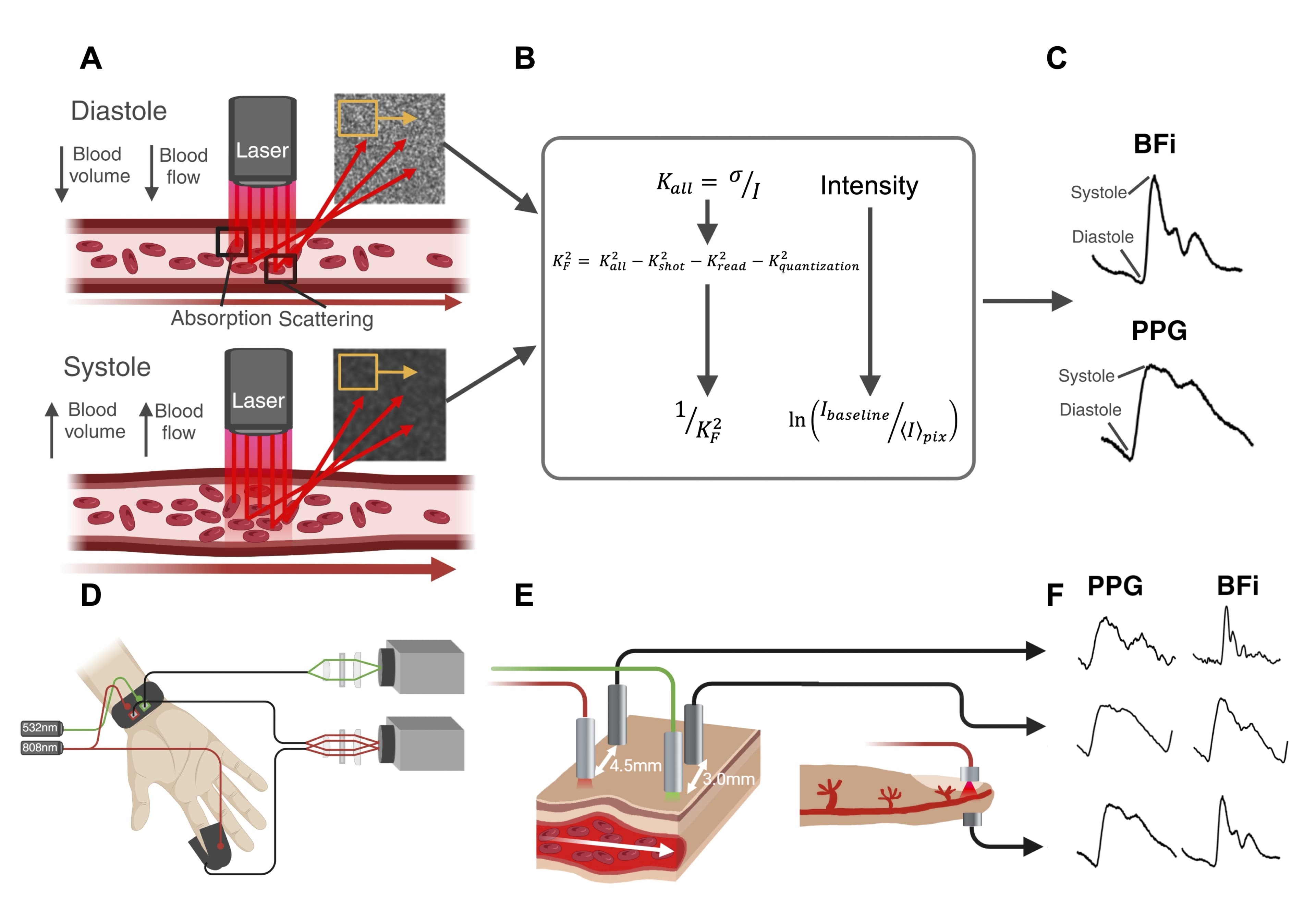
This ongoing work examines how speckle contrast optical spectroscopy (SCOS) and cardiac-waveform analysis can support cuffless blood-pressure estimation. Timothy's current experiment investigates how measurement position affects signal-to-noise ratio, connecting experimental protocols, optical measurements, data analysis, machine learning, and wearable test hardware.
Timothy's contribution
Timothy leads an IRB-supervised experiment to optimize positional signal-to-noise ratio. His responsibilities include creating and implementing the measurement protocol, recruiting participants, taking measurements, and analyzing the data.
He applies XGBoost to predict blood pressure and classify hypertension using 80+ engineered cardiac-waveform features. He also analyzes and presents features from hypertensive and non-hypertensive subjects to identify patterns relevant to cuffless blood-pressure estimation.
Using Autodesk Inventor and additive manufacturing, Timothy develops an attachable base for wireless wearable benchmark testing.
Advisor-supported workflow
Earlier analysis used a project-specific dataset that Timothy constructed from raw scientific-trial data produced through studies run by postdoctoral advisor Ariane Garrett. That advisor-run data collection is distinct from the positional experiment Timothy now leads.
Under Garrett's advisement and with advisor-assisted code, Timothy adapted an existing XGBoost workflow for his dataset. His contribution includes experimental protocol development, dataset preparation, feature analysis, cohort comparison, and project-specific adaptation.
Positional measurements and waveform methods
The current experiment pairs a defined measurement protocol with participant recruitment, measurements, and data analysis under IRB supervision. Its aim is to optimize positional signal-to-noise ratio for cuffless blood-pressure estimation.
The analytical work uses 80+ engineered cardiac-waveform features and compares hypertensive and non-hypertensive subjects to identify relevant feature patterns. Participant-level data remains private.
Machine-learning workflow
Timothy applies XGBoost to blood-pressure prediction and hypertension classification within an existing advisor-supported workflow. The work combines project-specific data preparation and feature analysis with the established modeling pipeline.
Wearable test-base development
Autodesk Inventor and additive manufacturing support an attachable base for wireless wearable benchmark testing. This work connects the analysis to practical measurement hardware.
Current status
The research and positional experiment are ongoing. Preliminary findings have been presented internally. No quantitative model-performance result or clinical-validation claim is presented here.